🐶 Your Puppy’s Success Bundle — Essential Guides
Bringing home a Guardian Boerboel puppy is an exciting and important time — and preparation makes all the difference. Below are the official Guardian Boerboels resources we provide to help you start strong in every aspect of caring for your new companion.
🐾 Puppy Feeding & Nutrition Guidelines
To help your Guardian Boerboel puppy get the very best start, we have created a detailed feeding and nutrition guide outlining:
- Proper calcium & phosphorus ratios for large/giant breed growth
- Recommended protein percentages
- Approved food brands & formulas
- When to transition to Adult / All-Life-Stages food
- How to properly switch foods
- Probiotic & supplement recommendations
Proper nutrition is critical for joint development, skeletal growth, and long-term structural soundness.
📄 Download our full feeding guide here:
👉 Boerboel Puppy Feeding Suggestions (PDF)
🐾 Your Boerboel Puppy & Their Schedule
Bringing your Guardian Boerboel home is a powerful and exciting milestone. From the very first day, structure, routine, and consistency are the foundation of raising a confident, stable, and well-balanced guardian.
Inside this guide, you’ll find our detailed feeding schedule, crate training structure, potty-training framework, and supplement recommendations — the exact protocol we follow here at Guardian Boerboels to set our puppies up for long-term health, stability, and success.
We strongly encourage families to follow this schedule closely during the first several months at home. Consistency during this stage makes all the difference.
Download the full schedule below:
👉 Your Boerboel Puppy & Their Schedule
🦷 Puppy Teething & Bite Inhibition
Understanding the difference between mouthing and true biting is important.
Teething can be one of the most challenging parts of puppyhood — especially with powerful guardian breeds like the Boerboel. The urge to chew, mouth, and chomp is completely normal… but it must be managed correctly from the start.
As outlined in our official Guardian guide:
- Mouthing is playful and common in puppies
- True biting is usually fear or aggression based
- Even playful mouthing must be redirected and shaped properly
Your puppy should never learn that human skin is an acceptable chew toy.
🧸 Managing Mouthing the Right Way
- Always provide appropriate chew options
- Redirect hands/clothing to toys immediately
- Use crate time with a stuffed Kong or chew for downtime
- Avoid running, waving hands, or squealing playfully (this can encourage the behavior)
Consistency creates clarity. Clarity creates confident, respectful adults.
🎓 Teaching Bite Inhibition (Mouth Manners)
When pressure is too hard:
- Give a sharp “Ouch!” or high-pitched yelp
- Stop play immediately
- Resume only when calm
- Gradually reduce the pressure you allow
Your goal is to teach your puppy control — not fear.
🐾 Recommended Chew Enrichment
We recommend structured chew outlets such as:
- Bully sticks
- Durable bones
- Stuffed Kong toys
- Super Chewer–style subscription boxes
Appropriate chewing prevents destructive habits and supports healthy jaw development.
📥 Download the Full Guardian Guide
For a printable version of our complete Puppy Teething resource:
👉 Download the Guardian Puppy Teething Guide (PDF)

🐾 Puppy Biting
Puppy biting is normal, necessary, and part of healthy development — especially in a powerful guardian breed like the Boerboel.
Before bringing your puppy home, please take a few minutes to review this guide on bite inhibition and proper training response.
Consistency in the first 8–16 weeks is critical.
🔘 Download Puppy Biting Guide (PDF)
🏡 Crate Training & House Training Schedule
At Guardian Boerboels, we teach families that the crate is not punishment — it is sanctuary.
As outlined in our official Crate/House Training Timetable , your puppy’s crate should be:
- A safe resting place
- A calm retreat
- A structured training tool
- Never used emotionally
Structure builds confident, stable guardian dogs.
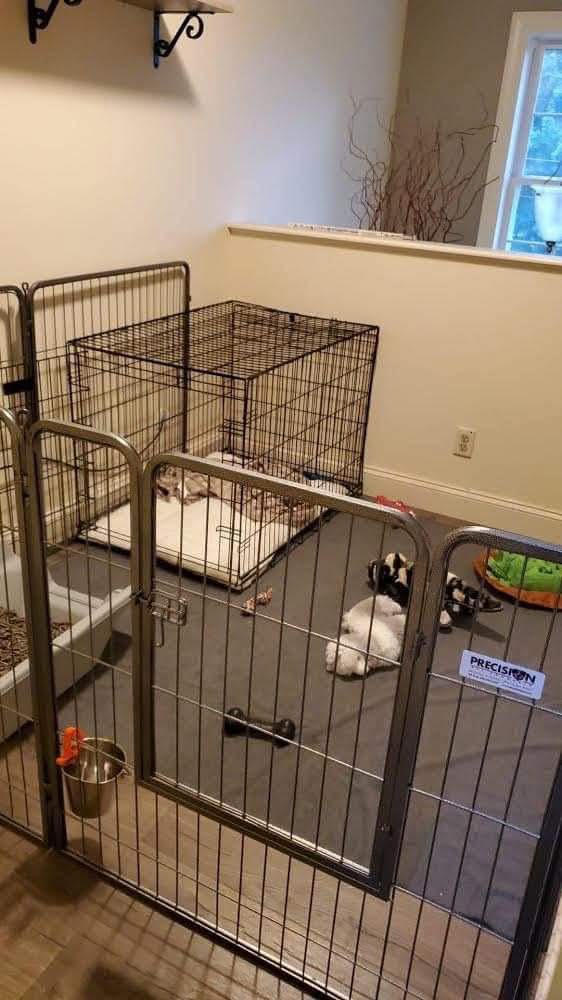
📏 Proper Crate Setup
- Crate should allow standing, turning, and lying down comfortably
- NOT large enough to sleep in one corner and potty in another
- Use a divider for growing puppies
- Feed meals in the crate when possible
We recommend double-door crates with dividers and durable crate pads.
🌙 Nighttime Routine
For the first several weeks:
- Place the crate in your bedroom
- Keep interactions calm and minimal
- Do not “converse” with whining
- Take outside if necessary, then return calmly
Consistency at night prevents long-term sleep issues.
🚽 House Training Basics
Puppies should go outside:
- Immediately after waking
- 20 minutes after eating
- After play sessions
- Every 3 hours during the day
For working families, a midday potty break is essential.
Guardian puppies are litter-box familiar before leaving us, making transitions smoother.
🕒 Sample Schedules
Your guide includes:
- Full-time working owner schedule (3 meals/day)
- Home-all-day schedule
- Night adjustment guidance
- “First Couple Days” tracking instructions
The key principle:
Write down elimination timing the first few days and adjust accordingly.
📥 Download the Full Crate & House Training Timetable
👉 Download the Guardian Crate Training Schedule (PDF)

🌎 Socializing & Training Your Guardian Puppy
“Statistically speaking, your puppy has a much greater risk of developing permanent behavior issues if not properly socialized than of contracting a disease while properly socializing.”
At Guardian Boerboels, socialization begins before your puppy ever comes home.
Your puppy has already been:
- Exposed to household noises (washing machines, pots & pans, daily activity)
- Desensitized to sound through 24-hour audio exposure
- Introduced to handling (ears, eyes, teeth checks)
- Conditioned to potty cues
- Crate and bed familiar
Now it is your turn to continue building a confident guardian.
🧠 The Critical Socialization Window
The sensitive period of socialization is between 3–14 weeks of age
This stage determines whether your Boerboel becomes:
- Confident or cautious
- Stable or reactive
- Balanced or fearful
Proper exposure must always be positive, calm, and controlled.
✅ What To Do
Expose your puppy (safely) to:
- Many types of people
- Car rides and new environments
- Healthy, vaccinated dogs
- Different surfaces, sounds, smells
- Public settings you want them comfortable in as adults
If something startles your puppy — pause, create safety, and reintroduce slowly with praise and treats.
Keep it FUN.
⚠️ What To Avoid
Until fully vaccinated:
- Dog parks
- Pet elimination areas
- Unknown dogs
- Overwhelming crowds
- Fireworks or loud chaos
If your puppy becomes fearful, do not force the issue.
Confidence is built — not pushed.
🎓 Training Principles for Guardian Breeds
- You decide when play begins and ends
- Set rules immediately and be consistent
- Short sessions (a few minutes daily)
- Do not overtrain
- Protect their spirit
This is a powerful guardian breed that thrives on leadership, clarity, and fairness.
Never break their confidence. Shape it.
🧸 Enrichment & Mental Stimulation
Prevent boredom before it becomes destruction:
- Rotate toys
- Set up activity areas
- Provide structured chew outlets
- Use positive reinforcement
A bored Boerboel puppy becomes a creative one.
📥 Download the Full Socializing & Training Guide
👉 Download the Guardian Socializing & Training Guide (PDF)

📋 Puppy Socialization Checklist
Raising a stable Guardian Boerboel requires intentional exposure — not random encounters.
As outlined in the Socialization Checklist , the goal is:
Positive experiences — not neutral or negative ones.
Your puppy’s response matters just as much as the exposure itself.
🧠 How to Track Progress
The checklist includes a simple scoring system:
Needs Work
1 – Overaroused (growling, lunging, nipping)
2 – Avoiding or hesitant
3 – Freezing or shutting down
Going Well
4 – Calm, relaxed, playful (with food reinforcement)
5 – Calm, confident, playful (without food)
You may also mark progress with + or – to track improvement over time.
This level of exposure builds a dog that is confident, not reactive.
🏆 Guardian Standard
We do not raise timid dogs.
We do not raise chaotic dogs.
We raise stable, thinking guardians.
This checklist helps you continue the foundation we have already started.
📥 Download the Full Socialization Checklist
👉 Download the Guardian Socialization Checklist (PDF)
🛡️ Guardian Leadership Protocol
Nothing In Life Is Free (NILIF)
At Guardian Boerboels, we recommend a simple leadership system called Nothing In Life Is Free (NILIF) to help your puppy grow into a respectful, confident adult.
The concept is simple:
Your puppy must perform a known command (sit, down, place, eye contact) before receiving anything they want — meals, treats, leash on/off, going outside, playtime, attention, or furniture access.
Pushy behaviors (jumping, pawing, whining, barking for attention) are calmly ignored. When your puppy settles and responds appropriately, they earn the reward.
This system:
- Establishes clear leadership
- Prevents entitlement and resource guarding
- Builds confidence
- Reduces anxiety
- Creates a stable family companion
Consistency from every family member is key.
📄 Download the full guide here: